Boardrooms and Conference Rooms
Specify glare-control systems that support screen visibility and professional daylight conditions throughout meetings.
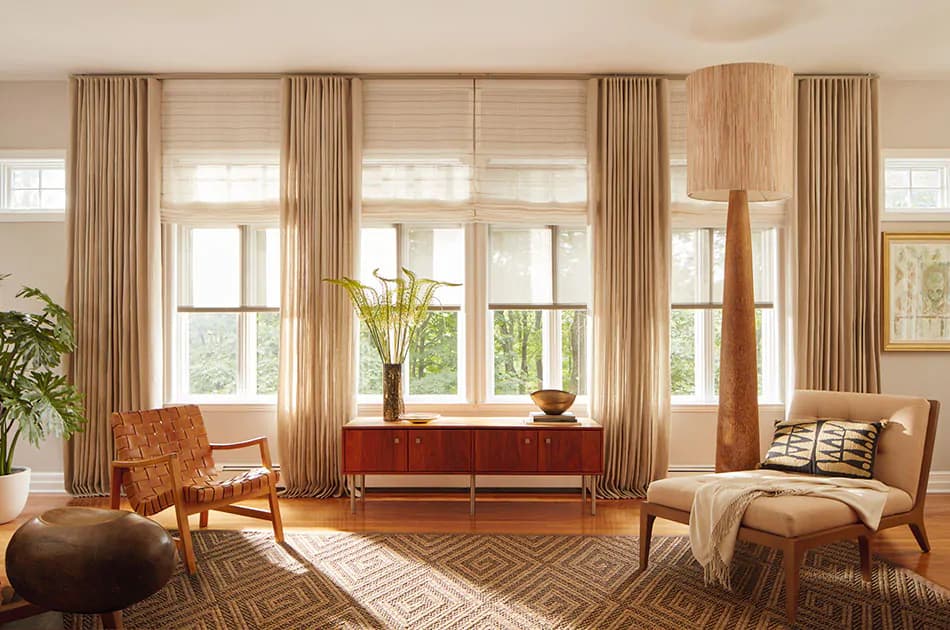
Commercial-grade window treatments for offices, executive suites, and multi-room properties requiring consistency, durability, and operational clarity.
Specify glare-control systems that support screen visibility and professional daylight conditions throughout meetings.
Use hospitality-grade blackout and privacy layers with consistent installation standards across units.
Balance durability and ambiance using layered treatments that protect finishes while maintaining a refined feel.
Choose ripplefold, euro pleat, French pleat, or wave fold based on architecture, desired formality, and fabric behavior.
Decorative rods, traverse rods, and concealed tracks are selected for load, projection, and visual alignment with millwork.
Manual and automated systems are specified around usability, window scale, and long-term maintenance access.
Commercial window treatments require a different planning model than single-room residential scopes. The right package must balance design standards, durability, privacy, glare control, and installation logistics across many spaces.
We support executive offices, conference environments, boutique hospitality spaces, multi-unit properties, and client-facing commercial interiors where consistency and reliability are operational requirements, not optional upgrades.
Our approach is design-led and performance-aware. We treat specification as a strategic phase, not an afterthought. Every recommendation is measured, contextual, and tied to how rooms are used throughout the day. For clients searching for **commercial window treatments Los Angeles**, this means recommendations are built around architecture, daylight behavior, and long-term operational reliability rather than generic product templates.
Los Angeles commercial projects often operate under active occupancy, strict scheduling, and mixed room use conditions. Strong outcomes depend on room-type standards, coordinated phasing, and clear stakeholder communication from specification through installation.
Beyond aesthetics, local context affects durability, comfort, and user behavior. Coastal reflection, hillside exposure, neighborhood proximity, and floor-to-ceiling glazing all change how treatments should be specified. A premium result comes from mapping these variables early, then selecting materials and systems that remain consistent under real daily conditions.
This service is typically the right fit for projects that require premium execution, clear technical planning, and high visual discipline. That includes large custom homes, architect-designed renovations, coastal properties, penthouse units, executive environments, and select hospitality scopes where consistency across multiple rooms is essential.
In these project types, window treatment choices have outsized impact. They shape proportion, acoustics, daylight comfort, privacy behavior, and final perceived quality. By resolving these factors up front, we reduce rework, protect schedule, and improve final installation outcomes.
Room-specific strategy is important because each space carries a different performance objective. A primary suite usually prioritizes privacy and darkness. A living room usually prioritizes flexible daylight and visual openness. A conference room may prioritize glare control and consistency. Designing every room with the same treatment logic can make the entire property underperform.
When clients compare options, we map each room against use-case, exposure, and aesthetic direction. In practice, this means one property may include several treatment types working together: drapery in formal rooms, shades in high-use zones, and layered systems where privacy and daylight control both matter.
The goal is cohesion without uniformity. Every room should feel intentional and related to the broader design language, while still getting the specific performance it needs.
These technical variables are what separate brochure-level proposals from professional specification. They are also the reason premium projects benefit from consultation and measured planning before fabrication begins.
For commercial and multi-room projects, scope can include phasing logic, consistency standards, and room-type packages to simplify execution at scale.
We do not publish one-size-fits-all pricing because it is often misleading for serious projects. Instead, we provide accurate pricing guidance after consultation and measurement, so your quote reflects real project conditions and performance requirements.
A strong pricing discussion should include both immediate and long-term value. Lower-cost options may appear attractive upfront, but if they compromise durability, operation quality, or design alignment, lifecycle cost usually increases. Better specification at the beginning generally reduces replacement risk and prevents expensive rework.
To make your first consultation more productive, prepare reference photos, room priorities, and any existing constraints (HOA rules, building access windows, timeline targets, or preferred completion dates). If available, provide rough opening counts and note any especially tall, wide, or difficult-to-access windows.
This preparation helps us give more actionable guidance early and improves overall timeline certainty.
A disciplined specification workflow avoids these issues and protects both visual quality and schedule confidence.
Most projects move through four phases: consultation, measured specification, fabrication, and installation. Timeline depends on scope, product lead time, and installation complexity. One-room upgrades may be delivered faster, while whole-home and multi-room programs require phased planning.
During consultation, we outline realistic sequencing so expectations are clear before decisions are finalized.
Commercial scopes are planned by room type and operational intensity. Boardrooms, conference rooms, and presentation zones prioritize glare control and privacy transitions. Executive offices typically require a more tailored visual finish with discreet operation. Reception and public-facing areas are specified for first-impression quality plus durability under frequent use. Hospitality and multi-unit environments emphasize repeatable standards across many rooms.
Commercial pricing is driven by room count, repeatability of standards, control system depth, compliance constraints, and installation windows in occupied properties. Projects with strong standardization usually gain procurement and labor efficiency. We quote by room archetype and phase so stakeholders can forecast budget impact accurately before full rollout commitments.
If you are comparing options and want practical guidance for your specific windows, room priorities, and timeline, the fastest next step is to use our 3-step quote flow. We will review your project context and recommend a clear path forward.
We provide tailored pricing guidance after consultation and measurement so recommendations reflect true project scope rather than generic ranges.
Primary search focus: commercial window treatments Los Angeles. Share your goals and we will recommend the best-fit materials, system architecture, and installation pathway.
Yes. We sequence work by floor, wing, or department to keep projects moving without disrupting daily operations.
Yes. We specify shade fabrics and control strategies that improve visibility on screens while maintaining a professional atmosphere.
Yes. Motorized solutions can be included when operation efficiency and room control consistency are priorities.
Our team can review your space and provide recommendations based on style, functionality, and timeline.